
Apr 17th 2009 07:48 am Works with goats and possums!
Yesterday, I wrote, “…if you’re an Andrew Lloyd Webber fan or if you just want to hear a song well sung, you can see Susan here.” I did not say Mr. Webber had anything to do with the musical Les Misérables. I just assumed that if you enjoyed Mr. Webber’s music, you’d like this song. OK, that’s pretty lame. I goofed.
Grateful for an opportunity to correct my mistake and grateful for something to talk about today, let me hasten to say the producer of the English version of Les Misérables which we’re talking about here was Cameron Mackintosh. The show opened in London in 1985; it was an adaptation of a French musical that had a successful but contractually plagued run in Paris beginning in 1980. You can get the long version of the musical’s history and all involved from Wikipedia or any number of other, probably more reliable sources.
And let us not forget to give credit to the author of the 19th-century novel from which it all flows, Charles Dickens.
Posted by jimmyjohnson / Vintage A&J
37 Responses to “Works with goats and possums!”


Bob on 17 Apr 2009 at 8:24 am #
Charles Dickens? You’d better watch where Hugo, Victor!
Mark from Maine on 17 Apr 2009 at 8:59 am #
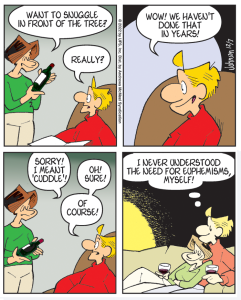
My cats refer to our bird feeders as “bait.”
Floyd in Nashville on 17 Apr 2009 at 9:40 am #
Mark – Really? my wife refers to our bird feeders as “squirrel feeders”.
Stef on 17 Apr 2009 at 9:48 am #
I like this cartoon! When I was a kid, my Dad dyed our black and mostly white cat green, because he thought it would be funny. However, he told people that he did it so that the cat could sneak up on birds on the grass without being seen!
Mark in Boston on 17 Apr 2009 at 11:02 am #
Are you sure you don’t mean A Sale of Two Kitties by Darles Chickens?
Hedgewitch on 17 Apr 2009 at 11:05 am #
Mine sit in the bird feeder (it’s a open one) and “wait”. I hear the birds and squirrels laughing until they faint in the trees. Like they can’t see a 15 lb black cat overflowing in a feeder that holds 10 lbs.
LVJeff on 17 Apr 2009 at 12:15 pm #
I’m trying to determine whether or not “Charles Dickens” was just a really subtle joke
Yeah, I think the only reason why some people might not want to associate or confuse Les Mis with Webber is I know there are those who think Webber is a hack. Me, I don’t know enough about his stuff to have an opinion.
nonegiven on 17 Apr 2009 at 1:00 pm #
Spooky (14 lb black cat) used to lay on the same flimsy lower branch that the neighbor’s bird feeder hung from. It made the branch hang 2-3 feet lower. The birds would congregate in the upper branches and scold him. I once saw him chase a squirrel halfway up that same tree, it’s a miracle he didn’t break a branch and fall out.
Sili on 17 Apr 2009 at 1:55 pm #
Charles Dickens?!
Everyone knows that La Traviata was written by George Eliot.
Carole in Hawaii on 17 Apr 2009 at 2:41 pm #
Jimmy, I know you don’t do colors for the strip but what were the folks at the syndicate thinking when they did the strip for today?? I know about the purple cow but I’m not sure about a purple Luddie??? Come on, guys!!
Ron in Provo on 17 Apr 2009 at 2:49 pm #
Here’s a bit more about Susan Boyle — she did a track on a charity CD a few years ago:
http://www.dailyrecord.co.uk/news/scottish-news/2009/04/16/exclusive-susan-boyle-s-first-ever-song-release-revealed-listen-to-it-here-86908-21283564/
Enjoy!
Lost in A**2 on 17 Apr 2009 at 4:55 pm #
Carole, Ludwig *is* purple. IIRC, he’s modeled on a Russian Blue.
Mark in Boston on 17 Apr 2009 at 6:58 pm #
So Susan Boyle really IS a trained, experienced singer. I thought so. Voices like that don’t magically happen overnight.
Brian in Acton on 17 Apr 2009 at 8:36 pm #
Since she sang a song from the musical, I think it more appropriate to acknowledge the composer, Claude-Michel Schönberg, rather than the producer. After all, the erroneous attribution was to a composer of other musicals.
Bonnie Jeanne in Pittsburgh on 17 Apr 2009 at 8:59 pm #
We bought a bird feeder to entertain the cat and it is working quite well. She is an indoor cat so no birds are in danger. Besides, I don’t think she would know what to do with food that flies away.
Jean from Dahlonega GA aka Trapper Jean on 18 Apr 2009 at 6:34 am #
We have hummingbird feeders up on our deck and our cats will sit on the chairs inside and watch them as if they actually had a chance of catching one. I get a great deal of amusement out of watching the cats watch the birds.
Absolutely loved Susan Boyle! Fabia Cerra was fun to watch, too. Thanks for that link, IM from UK.
LV Jeff, from “Jesus Christ Superstar” on up, I’ve loved Andrew Lloyd Webber. As I mentioned before, I’m having great fun watching “Any Dream Will Do”, the search for a new Joseph for “Technicolour Dream Coat”, mostly to see John Barrowman, but also because Lloyd Webber is there and making comments on the contestants.
Floyd in Nashville, my husband won’t let me put up seed feeders because he doesn’t want to feed the local squirrels and rats.
Jimmy, while “Oliver!” did start this whole literature-to-musical thing in 1968, that’s the only Dickens on stage. I don’t much care for Les Mis, but Cameron MacKintosh is “Mr. Producer”.
Joe Pal in Amesbury on 18 Apr 2009 at 11:56 am #
“..while “Oliver!” did start this whole literature-to-musical thing in 1968, that’s the only Dickens on stage.” N
Joe Pal in Amesbury on 18 Apr 2009 at 12:02 pm #
“..while “Oliver!” did start this whole literature-to-musical thing in 1968, that’s the only Dickens on stage.”
Not so! How many times has “A Christmas Carol” been done? Then there’s Mystery of Edwin Drood and Nicholas Nickleby
Jym on 18 Apr 2009 at 8:46 pm #
=v= I’ve been making exactly the same blunder about Andrew Lloyd Webber, in front of God and everyone, plus my Facebook friends.
Jean from Dahlonega GA aka Trapper Jean on 18 Apr 2009 at 10:08 pm #
Joe Pal in Amesbury- true, but “Oliver!” is the only one on Broadway that came to mind.
Mark from Maine on 19 Apr 2009 at 7:22 am #
Floyd – That still make it bait, doesn’t it?
Dee in Lebanon, TN on 19 Apr 2009 at 8:04 am #
Ron in Provo:
Thank you so much for the link to Susan Boyle’s sultry rendition of “Cry Me a River.” It is a wonder she was not discovered then.
Rick in Shermantown, Ohio on 19 Apr 2009 at 6:20 pm #
I just listened to “Cry Me a River,” and I thought that I was in heaven.
Anyone who knows me will tell you that I am rarely impressed with anything or anyone.
But if Boyle doesn’t release a CD and soon, it will be one of the biggest disappointments of my musical life.
E from Massachusetts on 20 Apr 2009 at 4:00 am #
Getting to today’s comic — wow! I’m surprised they let you get away with it. And I loved it. I love that Arlo still thinks Janis is hot.
E from Massachusetts on 20 Apr 2009 at 4:05 am #
Mark in Boston said “So Susan Boyle really IS a trained, experienced singer. I thought so. Voices like that don’t magically happen overnight.”
I don’t think singing a track on a charity album done by a town council really counts as “experienced”, but even so… no one said she had never opened her mouth to sing before. Or that she had never taken lessons, which she may have done. A LOT of people take lessons, and try to get heard, for years and years and years, and it just never happens.
Mark in Boston on 20 Apr 2009 at 8:20 am #
E: There’s a voice as good as that in every town and a hundred thousand in New York City, either not working in music or struggling to make a living with music. If America’s Got Talent or Britain’s Got Talent wanted to, they could fill every show with professional-quality performers. And if they did, their audience would plummet.
Norm in Utah on 20 Apr 2009 at 9:19 am #
Re: Dickens and the Stage. Let us not forget “Pickwick.”
Rick in Shermantown, Ohio on 21 Apr 2009 at 5:21 am #
Mark:
Evidently, you have not heard the singers in this town or many other towns in Ohio.
Perhaps Ohio is exempt from your observation, and every other place in the country has an abundance of superbly gifted singers.
Yes, we have some excellent voices, but I don’t know of one who has the quality of Boyle and of those better than she.
However, in one aspect, you are correct. Many other people have a voice superior to Boyle’s, and I imagine that their appearances run the gamut. Why, then, do some people become unimaginably successful while others do not?
For an interesting viewpoint, consider reading The Black Swan: The Impact of the Highly Improbable, Nassim Nicholas Taleb’s examination of probability theory and economics, along with a few other items.
And, as long as I am suggesting books, you might enjoy Will in the World: How Shakespeare Became Shakespeare by Stephen Greenblatt, Flyboys: A True Story of Courage by James Bradley (George Bush is the only one who survived the attacking of the Japanese-held island), A Short History of Nearly Everything by Bill Bryson, Why People Believe Weird Things: Pseudoscience, Superstition, and Other Confusions of Our Time by Michael Shermer, and Snobbery: The American Version by Joseph Epstein.
Right now, I am waiting for The Lords of Finance to arrive at my local library. What books do you recommend that I add to my list?
Rick
Mark in Boston on 23 Apr 2009 at 11:12 am #
Rick,
No Susan Boyle-quality singers in your town? Have you gone to every Sunday Morning church service in town and heard not one? If you go to all the weddings in town for a year, you’re sure to hear one local voice that will surprise you.
Why do some people become successful and others do not? A lot has to do with being in the right place at the right time. To have a good shot at being in the right place at the right time, go to a lot of likely places a lot of times.
For instance, if you are woman looking for a boyfriend, go to the laundromat on Sunday morning. If a man is doing his own laundry on Sunday morning, he doesn’t have a girlfriend or wife to do it for him and he keeps clean. If he does have a girlfriend and he does his own laundry anyway, he’s an especially good catch.
To add a similar book to your list of books, look at The Change Function: Why Some Technologies Take Off and Others Crash and Burn by Pip Coburn.
For entertainment, get the new (in 2007) Royal Shakespeare Company edition of the Complete Works of William Shakespeare, published by Modern Library. You can find it on sale for $41, or just a bit more than a dollar per play.
Rick in Shermantown, Ohio on 24 Apr 2009 at 5:19 am #
Thanks for the tip about the book; I’ll check my local library this morning.
Shakespeare: Thanks, but I already have several books of his complete works. Is there something special about the introductions to the plays or another feature in the Royal edition?
In regard to technology, think about reading Technoloply by Neil Postman. Actually, anything by Postman is excellent. My favorite is Amusing Ourselves to Death: Public Discouse in the Age of Show Business. His focus was on the impact of television upon American culture, and he wrote the book before the Internet became what it is today. Still, when I return to the book twenty years later, I see how his thoughts about television can also apply to the Net.
Singers: I have heard many local singers with superb voices, but they don’t match Boyle’s. Have I heard others that are better? Absolutely. But not often. I don’t know what I would think of her rendition of other songs, but Cry Me a River is one of the best I’ve ever heard.
Still and all, I suspect that her fifteen minutes is already over.
Joyce in Indy on 24 Apr 2009 at 8:54 am #
Why do some suceed and others not? I suspect it also has a lot to do with drive. I love to sing and I’ve been told I have a good voice and probably with training I could have a better one. But I have other things I do with my life, things more important to me than making a career out of singing. I also suspect that if I was forced to work really hard at it, I wouldn’t enjoy singing as much as I do. (I also whistle). I would bet money (although not much, I don’t have much) that many of the excellent singers in our churches and community theater venues feel the same way.
Mark in Boston on 24 Apr 2009 at 6:08 pm #
Rick: The new RSC Shakespeare explains all the dirty jokes.
Besides which it’s very well researched, has good introductions, and is edited by people who are in the business of performing the plays.
Rick in Shermantown, Ohio on 25 Apr 2009 at 7:34 am #
I see. I’ll take a look at it.
So far, my favorite is my Penguin edition.
In terms of the dirty jokes, I have always liked Shakespeare’s Bawdy.
Question for you: I once read a rumor (and it is only a rumor – can’t find anything conclusive in print) that some later editor removed much of the “four-letter words,’ cussing, and swearing from Shakespeare’s plays. Do you know anything about that?
Perhaps the rumor was based on the idea that the Elizabethans loved “earthy” language and saw nothing wrong with cussing and “four-letter words.” I’m not sure how they felt about taking the Christian’s god’s name in vain, though.
In addition to what I read about their love of “earthy” language, I also once read that the Virgin Queen was renowned for her ability to cuss while holding royal court. I don’t know if that has been verified, though.
Rick
Hans Peter Verne on 25 Apr 2009 at 1:22 pm #
Ooh – ooh – ooh, I get it! It’s a Monty Python reference! “That’s Dikkens with two Ks, the well-known Dutch author.”
http://mzonline.com/bin/view/Python/BookshopSketch
Mark in Boston on 25 Apr 2009 at 6:21 pm #
Rick,
We have the First Folio and some quartos so we can at least go back that far. We can recover from any later editing.
Sometime around the 17th century, producers started putting happy endings on the tragedies. Romeo gets back to Juliet before she can kill herself.
In the 19th century several editors produced “Purified” editions with all the dirty stuff removed. The most famous of these was Thomas Bowdler from whom we get the word “Bowdlerized” meaning “with all the good parts taken out”. Lewis Carroll wrote of his own intention to produce an edition of Shakespeare suitable for little children to read. He complained that Bowdler left in so much unsuitable material that he might as well not have changed anything at all.
There’s a story that Bowdler sanitized “Desdemona plays the strumpet in bed” by changing one letter: “Desdemona plays the trumpet in bed.” (I don’t think it’s true because I haven’t found that line in Othello.)
Concerning taking sacred names in vain: I don’t know of examples of “By Christ” or “By God” in Shakespeare but it’s full of minced oaths like “By’r lakin” (“By Our Ladykin”, i.e. by our dear Lady Mary the blessed mother of God) and “zounds” (“By God’s wounds”). Perhaps the oaths you would hear often in the street were not allowed from the stage.
There was heavy political censorship hanging over the Elizabethan theatre. Plays that were unflattering to the current regime or appeared to criticize the current regime indirectly were suppressed completely. One play, “The Isle of Dogs”, gave such offense that all the theatres were shut down for a short time.
Rick in Shermantown, Ohio on 26 Apr 2009 at 7:39 am #
Thanks, but I am familiar with that information, along with Elizabeth’s famous phrase, “Know ye not that I am Richard II?” and the censorship of the abdication scene, etc. Political and religious censorship have always existed.
I was referring to the idea that the very first printings of Shakespeare’s works were not what was performed on stage.
Have you heard anything definitive about that?
Mark in Boston on 26 Apr 2009 at 9:02 pm #
@Rick:
It’s true that the printed plays are not exactly as performed, but that is because there was never a single “canonical” version. It wasn’t like a Beethoven symphony where you play every note as written; it was more like a Broadway play where a song might be added or dropped in a production.
At the Globe Theatre, the time limit was three hours — the doors opened at a certain time, and everything had to be cleared out at a certain time. That meant a total of about 2,500 lines. A court performance would often be longer, with interpolated songs, dances, masques etc.
Every new play started with a prologue. We have the prologue for Romeo and Juliet but not for most of the plays. Maybe the only prologues that were printed were the ones Shakespeare wrote himself. Sometimes the prologue was written, used for the first few performances and then thrown out. Often a new prologue was written by a different author for a revival.
The Christopher Sly business at the beginning of Taming of the Shrew gives us a look at material that might be added for a performance. It is not usually performed. It doesn’t add anything to the play; maybe it was a satire on something that had actually happened.